
Starting a new job is an exhilarating experience. You focus on the new desk, the new team, and the exciting projects ahead. However, behind the scenes of every successful career lies a trail of paperwork. This isn't just "HR stuff"—it is your professional identity.
A career is a journey, and just like a traveler needs a passport and visas, a professional needs a specific employee documents list to move from one milestone to the next. Documentation provides legal security, financial proof, and professional credibility. Without a clear employment documents timeline, you might find yourself struggling during background checks or salary negotiations later in life.
This guide will walk you through the entire lifecycle of employment documentation, ensuring you know exactly what to collect and when to ask for it.
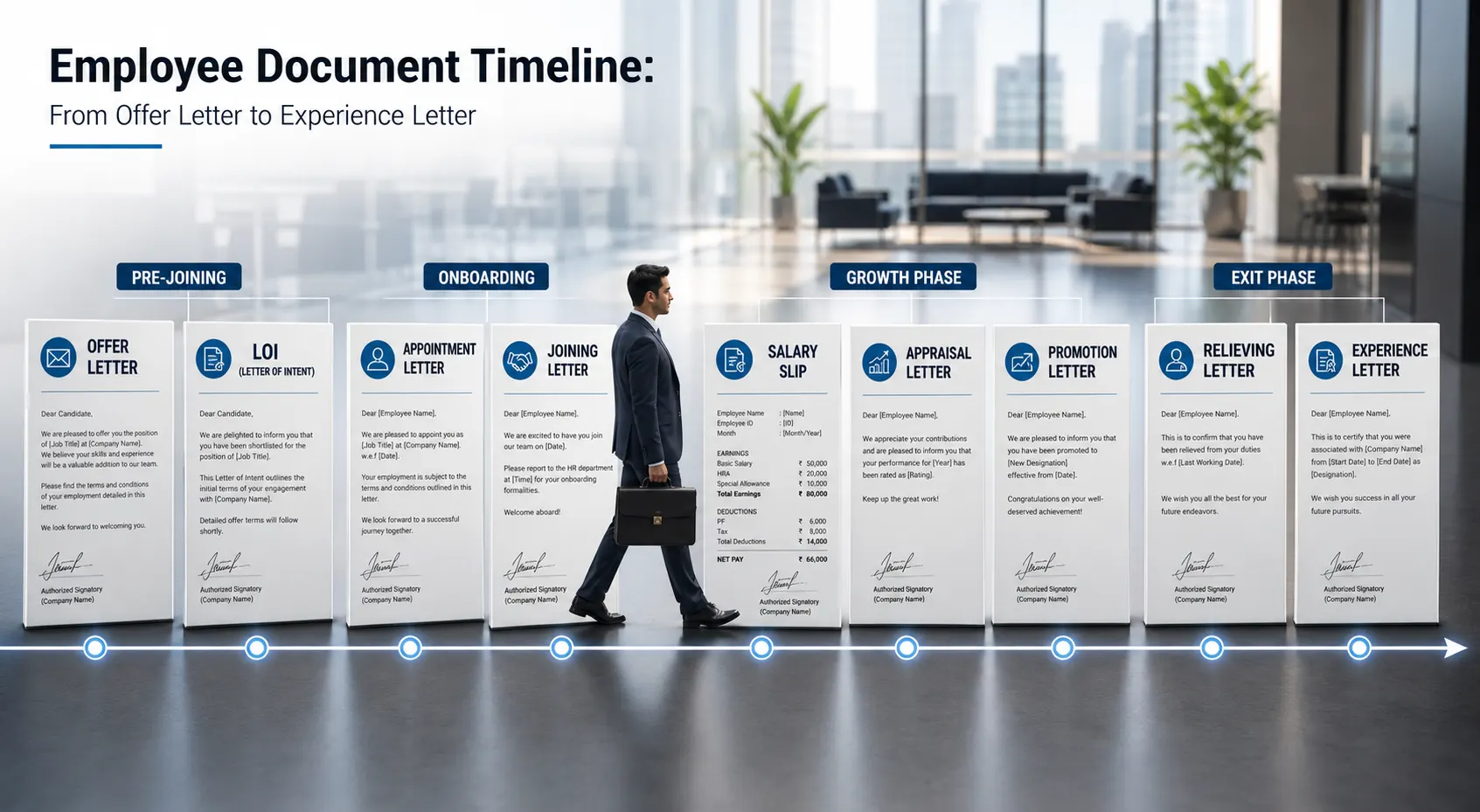
Phase 1: The Invitation (Pre-Joining)
Before you even step foot into the office, the documentation journey begins. This phase is all about the intent and the formal proposal.
1. Letter of Intent (LOI)
- What it is: The Letter of Intent is a preliminary document expressing the company's desire to hire you. It is often less detailed than a formal offer.
- When it is given: Usually immediately after the final round of interviews if the company wants to "lock you in" while they process the formal paperwork.
- Why it matters: It gives you the confidence to stop attending other interviews. However, remember that an LOI is usually not a legally binding employment contract; it is a declaration of interest.
2. Offer Letter
- What it is: This is the formal invitation to join the company. It outlines the core components of your employment.
- When it is given: After the LOI or directly after the selection process.
- Why it matters: The Offer Letter contains your job title, salary (CTC), joining date, and location. You must sign this to signify your acceptance of the terms.
Phase 2: The Commitment (Onboarding)
Once you accept the offer and arrive on your first day, the relationship becomes official. This is the "onboarding" phase where the legal groundwork is laid.
1. Appointment Letter
- What it is: While many people confuse this with an Offer Letter, the Appointment Letter is the actual legal contract. It is much more detailed, often spanning several pages.
- When it is given: Usually on the first day of joining or within the first week.
- Why it matters: This document covers everything: your notice period, code of conduct, confidentiality clauses (NDA), and detailed leave policies. It is your primary protection in case of any workplace disputes.
2. Joining Letter (or Joining Report)
- What it is: This is often a document provided by the employee to the employer, or a simple form signed by both.
- When it is given: On the very first hour of your joining date.
- Why it matters: It serves as official proof of the date and time you commenced work. This is crucial for calculating your exact tenure and your first month's prorated salary.
Phase 3: The Growth Era (During Job)
Once you are settled, the documentation continues. These documents track your performance, your earnings, and your movement within the company hierarchy.
1. Confirmation Letter
- What it is: Most companies have a "probation period" (usually 3 to 6 months). A Confirmation Letter officially ends this period.
- When it is given: Once you successfully complete your probation.
- Why it matters: Before confirmation, you are often on a shorter notice period and may not be eligible for certain benefits like specialized insurance or bonuses. This letter marks you as a "permanent" employee.
2. Pay Slips (Salary Slips)
- What it is: A monthly record of your earnings, tax deductions (TDS), and contributions (like PF or 401k).
- When it is given: Every month, usually a few days after salary is credited.
- Why it matters: Pay slips are your financial lifeline. You need them to apply for loans, credit cards, or visas. They also serve as proof of income when you negotiate your salary at your next job.
3. Appraisal and Increment Letters
- What they are: Documents that record your performance review and any subsequent increase in salary.
- When they are given: Usually annually or bi-annually during the company’s "cycle."
- Why it matters: An Increment Letter is proof that your value to the company has increased. It updates your CTC (Cost to Company) officially.
4. Promotion Letter
- What it is: A formal document stating that you have moved to a higher rank or role with more responsibilities.
- When it is given: Whenever you are promoted.
- Why it matters: It validates your career progression. When a future employer looks at your resume, the Promotion Letter proves that you didn't just "stay" at a company, but you "grew" within it.
5. Warning Letter
- What it is: A formal notice regarding performance issues or policy violations.
- When it is given: When an employee fails to meet expectations or breaks company rules.
- Why it matters: While negative, it is a critical part of the employment documents timeline. It serves as a formal record of a "chance to improve" before more drastic actions are taken.
Phase 4: The Departure (Offboarding)
Every journey has an end. How you leave a company is just as important as how you joined. Professional offboarding requires three key documents.
1. Resignation Acceptance Letter
- What it is: A formal acknowledgment from HR or your manager that they have received and accepted your resignation.
- When it is given: Within a few days of you submitting your resignation.
- Why it matters: It confirms your "Last Working Day" (LWD). This prevents any confusion about when your notice period ends.
2. Relieving Letter
- What it is: A document stating that you have been officially "relieved" of your duties and have handed over all company property.
- When it is given: On your very last day of work.
- Why it matters: It proves that you left the company on good terms and have no "dues" (like unreturned laptops or uncleared payments) left.
3. Experience Letter
- What it is: A formal summary of your tenure, your last designation, and a brief mention of your conduct.
- When it is given: On or shortly after your last working day.
- Why it matters: This is perhaps the most important document for your future. It is the ultimate proof that you actually worked where you said you worked. If you are unsure of the process, learn How to Get an Experience Certificate to ensure you don't miss out on this vital record.
Phase 5: The Deviations (Exceptional Cases)
Not every career path is a straight line. Sometimes, there are bumps in the road that require specific documentation.
1. Performance Improvement Plan (PIP)
A PIP is a structured document given to employees whose performance has dipped below the required standard.
- What it includes: Specific goals, a timeline (usually 30-90 days), and the support the company will provide.
- Outcomes: If you meet the goals, you continue your role. If not, it may lead to termination. It is a document meant to help, though it is often viewed with stress.
2. Termination Letter
This is the document issued when an employer ends the employment relationship.
- With Cause: Issued for gross misconduct, theft, or policy violations. Usually involves immediate exit.
- Without Cause: Issued due to layoffs, restructuring, or "not a right fit." Usually involves a severance package or notice pay.
- What it includes: The reason for termination, final settlement details, and the effective date.
Special Section: What If You Don’t Have These Documents?
It is a common nightmare: You apply for your dream job, but you realize you lost your offer letter from three years ago, or your previous startup closed down without giving you an experience letter.
Real-World Problems:
- Background Verification (BGV) Rejection: Most big companies will fail your BGV if you cannot prove your previous employment.
- Salary Negotiation Hurdles: New employers may not believe your previous salary without pay slips.
Practical Solutions:
- Digital Backups: Always scan every document and save it in a secure cloud folder (Google Drive, Dropbox).
- Bank Statements: If you lack pay slips, bank statements showing "Salary Credit" from the employer can act as secondary proof.
- EPF Records: In India, for example, your Provident Fund (PF) portal shows every company that has contributed to your fund, acting as a government-verified work history.
- Tax Returns: Your annual tax filings (like Form 16) list your employers and total income.
If you find yourself in a spot where you have no formal paperwork at all, read our guide on How to Document Your Work Experience When You Have No Proof.
Why These Documents Matter for Your Career
You might think, "I have the skills, why do I need the paper?" Here is why:
- Background Verification (BGV): Modern companies hire third-party agencies to verify your history. If the dates on your resume don't match your Relieving Letter, it’s a red flag.
- Salary Proof: To get a 30% hike, you need to prove your current 100%. Your Increment Letter and Pay Slips are your only evidence.
- Legal Security: If a company tries to withhold your bonus or change your notice period unfairly, your Appointment Letter is your legal shield.
- Job Switching: Most companies will not let you join until you show the Relieving Letter from your previous employer.
Common Mistakes to Avoid
- Not Collecting Physical/Digital Copies: Never leave a company without your signed Experience Letter. Once you leave, getting hold of HR becomes ten times harder.
- Losing Records: Don't rely on your company laptop to store these documents. When you resign, you lose access to that laptop immediately.
- Ignoring Emails: Often, documents like Pay Slips or Appraisals are sent via automated portals. Download them every single month.
- Not Checking for Errors: When you receive a document, check your name spelling, joining date, and PAN/SSN details. A small typo can cause huge problems during BGV.
Conclusion
The journey from Offer Letter to Experience Letter is the story of your professional life. Each document is a milestone that represents your hard work, your growth, and your transitions. By staying organized and maintaining a complete employee documents list, you aren't just filing papers—you are building a secure foundation for your future career moves. Stay organized, keep digital backups, and always advocate for your right to proper documentation.
Need an Experience Certificate?
Contact Dreamsoft Consultancy today for a Free Career Documentation Audit.
Contact on WhatsAppVisit: experiencedocuments.com
