

Third-party BGV agencies verify your employment history by directly contacting past employers, cross-checking EPFO (PF) records, reviewing documents like payslips and relieving letters, and scanning professional profiles for consistency. Common red flags include title inflation, padded dates, and undisclosed terminations. In India, EPFO records serve as a reliable fallback when a company has shut down or merged. Most checks complete in 3–7 business days.
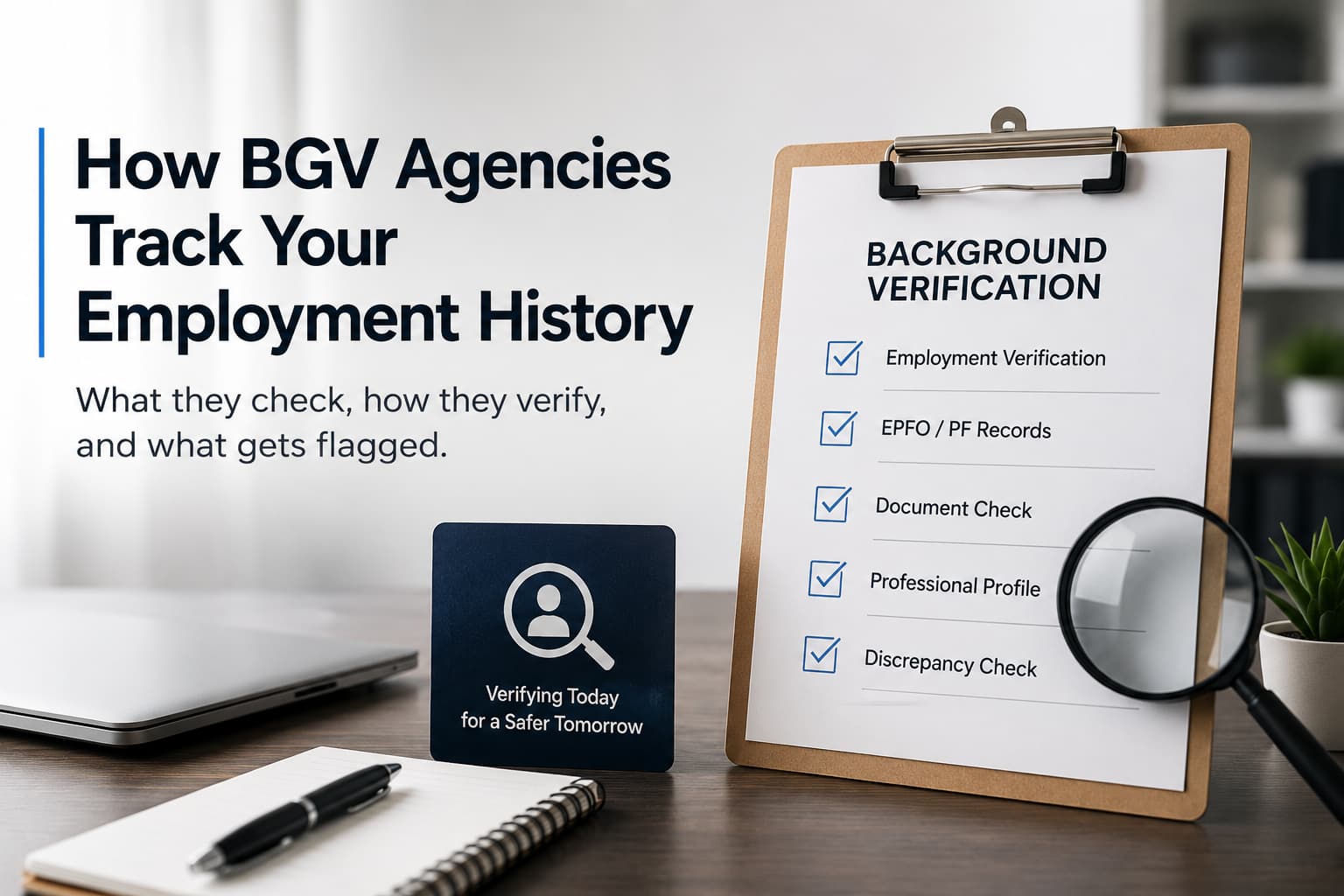
You've accepted an offer. The background check is in progress. And now you're wondering: what exactly are they looking for — and what will they find?
Here's a clear, honest breakdown of how third-party BGV agencies like AuthBridge, Securitas, KPMG, or FirstAdvantage verify your past employment — and what it means for you.
What Is Employment Verification in a BGV?
Employment verification is the process where a BGV agency independently confirms the details you listed on your résumé or job application.
They're not just checking if you worked somewhere. They're checking:
- Your official designation (title)
- Your dates of joining and leaving
- Whether you left on good terms (or are eligible for rehire)
- Sometimes, your reason for leaving
If what you claimed doesn't match what the employer's records say — even slightly — it gets flagged.
How Do BGV Agencies Actually Track Your Employment?
1. Direct Contact with Past Employers
This is the most common method. The agency calls or emails your former employer's HR department directly. They ask a few standard questions using your name, employee ID, and the dates you provided. HR confirms or denies the details against their records.
What can go wrong: If your dates are off by even a month, or your title doesn't match the official designation in the HR system, it shows up as a discrepancy.
2. Third-Party Employment Databases
In India, agencies often cross-check against platforms like the Employee Provident Fund Organisation (EPFO) portal or employer-linked HR databases. Your EPFO account tracks your contribution history — including which companies contributed on your behalf and for how long. This creates an almost automatic record of your employment timeline.
What this means for you: Even if a company has shut down or changed names, your PF records can still confirm you worked there.
3. Offer Letters, Payslips, and Relieving Letters
Agencies may ask you (or your new employer) to submit employment documents like:
- Offer letter and appointment letter
- Last three to six months of payslips
- Relieving letter or experience certificate
They then cross-verify these documents against what the previous employer's HR states. Inconsistencies between documents and HR records are a red flag.
4. LinkedIn and Professional Profiles
Some agencies quietly check your LinkedIn profile as a supplementary source — not as proof, but to check for consistency. If your LinkedIn says you held a "Senior Manager" role but your résumé says "Manager," or the dates don't match, that inconsistency will likely prompt a deeper check.
Important: LinkedIn data alone is never used as final proof. It's just one more signal.
5. Court and Regulatory Records (for Senior Roles)
For senior positions or roles involving financial responsibility, some agencies go further. They cross-reference your employment history with:
- MCA (Ministry of Corporate Affairs) records for directorship roles
- Court databases for pending litigation
- SEBI or RBI records for regulated industries
This is less common for mid-level roles but standard for CXO or legal/compliance positions.
What Happens When They Can't Reach a Past Employer?
This is more common than you'd think — especially if the company has:
- Shut down
- Been acquired or merged
- Changed its name
In these cases, the agency will typically:
- Ask you for alternative proof (payslips, form 16, or bank statements showing salary credits)
- Check EPFO records as a fallback
- Mark it as "unable to verify" if no documentation exists — not necessarily as a failed check
An "unable to verify" result is different from a "discrepancy found." Most hiring companies understand the difference. If you want to learn more about how to document your work experience without proof then read our blog.
What Gets Flagged as a Problem?
Not every gap or mismatch is a dealbreaker. But these things do raise concerns:
- Title inflation — claiming you were a "Team Lead" when HR records say "Senior Associate"
- Date padding — showing employment from January when you actually joined in May
- Hiding a termination — listing a "resignation" when the company's records show "terminated"
- Fake companies — listing employers that have no verifiable existence
- Overlapping tenures — dates that show you worked at two full-time jobs simultaneously without disclosure
Minor discrepancies — like a two-week difference in a joining date — are usually flagged but not treated as fraud. Major gaps or fabrications are a different story.
How Long Does Employment Verification Take?
Most agencies complete employment verification within 3 to 7 business days per employer in some cases like "BGV agency sends a field agent to physically visit an address you've listed" it takes some time .
Delays happen when:
- HR departments are slow to respond
- The company uses an outsourced HR or records management system
- Documents need to be physically verified
If your check is taking longer than two weeks, your recruiter should be following up with the BGV agency on your behalf.
What You Can Do Before Your BGV Starts
You don't need to panic. You just need to be consistent.
- Make sure your resume dates match your offer letters and relieving letters exactly
- Use your official designation from your appointment letter — not your working title
- If a company has closed down, gather your PF passbook, payslips, and form 16 in advance
- If you have a gap or an unusual exit, be upfront with your HR before the BGV starts — most companies appreciate honesty far more than a surprise discrepancy
The BGV process is thorough, but it is not a trap. It exists to verify facts — not to disqualify people.
The most important thing to remember: BGV agencies verify what you've claimed. Accuracy and consistency in your documents are your best protection.
Frequently Asked Questions
1. Can EPFO records replace a missing experience certificate?
Yes, in many cases EPFO records serve as a reliable fallback when a company has shut down or merged, confirming your employment timeline through contribution history.
2. What happens if my previous employer gives the wrong dates?
Discrepancies are flagged. However, you can provide supporting documents like offer letters, relieving letters, or payslips to correct the record.
3. Do BGV agencies check social media for employment proof?
LinkedIn is sometimes checked for consistency, but it is never used as final proof. It's just a supplementary signal to identify potential red flags.
4. How can I verify my employment if my past company no longer exists?
You can use alternative proofs such as bank statements showing salary credits, Form 16, EPFO records, or a legal affidavit from the company's former Director.
Need Help with Employment Documentation?
Contact Dreamsoft Consultancy today for a Free Career Documentation Audit.
Contact on WhatsAppVisit: experiencedocuments.com
