

What Is Tenure Verification?
Tenure verification is the process of confirming how long you actually worked at a company — your joining date, your last working day, and whether those dates match what you listed in your application.
It's a core part of any background verification (BGV) check, and it's usually the first thing that gets flagged if your résumé dates don't line up exactly with company records.
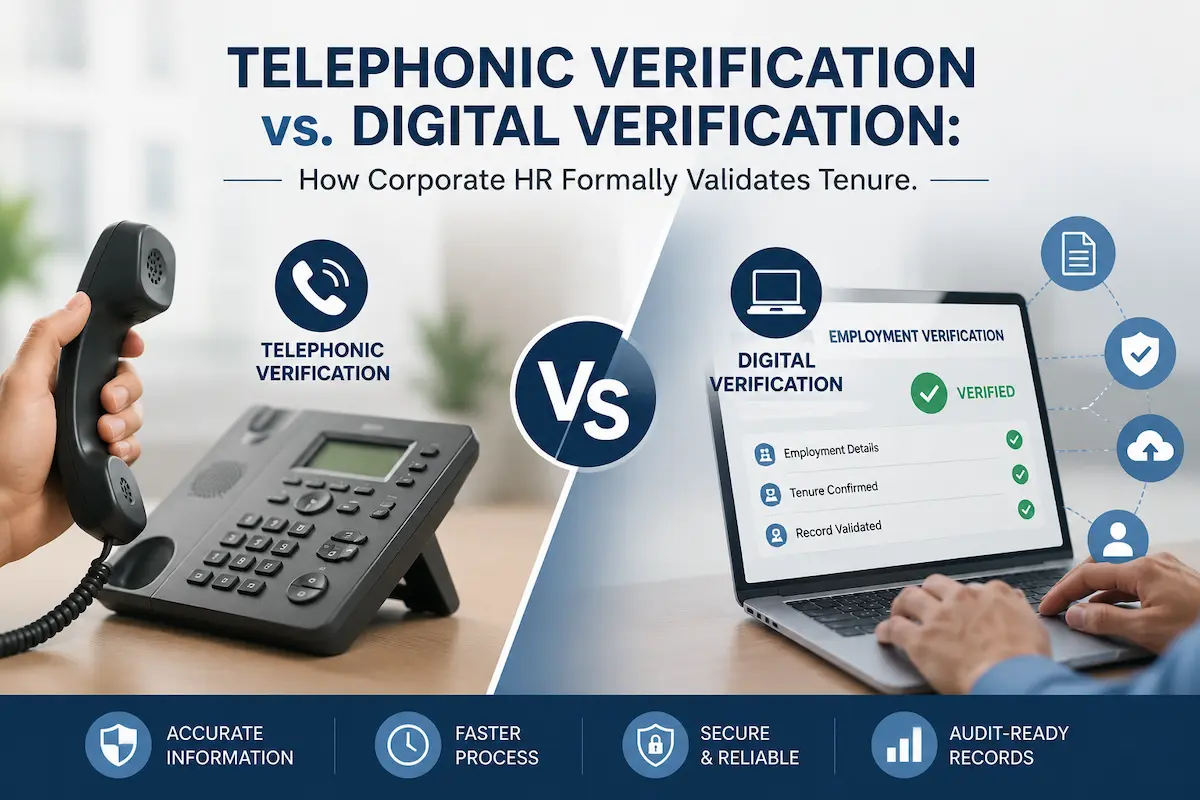
Telephonic Verification: How It Works
Telephonic verification is the more traditional method. A BGV agent or HR representative calls your former employer's HR department directly.
What Happens on the Call
The agent identifies themselves, references your employee ID or name, and asks HR to confirm:
- Your dates of joining and leaving
- Your official designation
- Whether you're eligible for rehire
- Sometimes, the reason for your exit
HR cross-checks this against their internal records while on the call, or calls back after pulling the file.
When Telephonic Verification Is Used
This method is common when:
- The company is small or doesn't use a structured HR database
- The company doesn't subscribe to a digital verification platform
- There's a discrepancy that needs immediate clarification
- The BGV agency couldn't get a response through digital channels
The advantage: It's fast and direct. A single call can resolve a query in minutes if HR is responsive.
The limitation: It depends entirely on HR's availability. If the contact has left the company or the department is slow to respond, this method can stall for days.
Digital Verification: How It Works
Digital verification uses automated systems, portals, or databases to confirm your tenure — without a phone call.
What This Looks Like in Practice
Most large companies and BGV agencies now use one or more of the following:
- HR verification portals like SpringVerify, AuthBridge's digital dashboard, or similar platforms where HR uploads or confirms employee records directly
- EPFO records — your Provident Fund contribution history, which shows which companies contributed on your behalf and for how long
- Employer-integrated databases where large companies pre-load employee tenure data for instant verification
The BGV agency submits a digital request, and the system either auto-confirms your details or flags a mismatch for manual review.
When Digital Verification Is Used
This is the default method for:
- Large enterprises and MNCs with structured HR systems
- Companies using third-party HRMS platforms (like Darwinbox, SAP SuccessFactors, or Keka) that integrate with verification agencies
- High-volume hiring scenarios where speed matters
The advantage: It's fast, consistent, and leaves a clear audit trail. There's no dependency on a single HR person being available.
The limitation: If a company's digital records are outdated or your designation was updated informally (without a system update), digital verification can flag a false discrepancy.
Which Method Will Be Used for Your Verification?
You usually won't be told in advance — and you don't need to be. The choice depends on your former employer's systems, not on anything you control.
As a general pattern:
| Company Type | Likely Method |
|---|---|
| Large MNC or enterprise | Digital verification |
| Mid-size company with HRMS | Digital, with telephonic backup |
| Small business or startup | Telephonic verification |
| Company that has shut down | EPFO records + documents |
Many BGV agencies actually use both methods together — a digital request first, followed by a telephonic call if records don't auto-confirm.
Do Both Methods Check the Same Things?
Yes. Regardless of method, HR is confirming the same three things:
- Did you actually work there?
- Do your stated dates match their records?
- Does your designation match what's on file?
The method changes how the information is collected — not what's being verified. A discrepancy flagged through a phone call carries the same weight as one flagged through a digital mismatch.
What Can Go Wrong With Each Method?
Telephonic Verification Risks
- HR contact has left the company and no one else has the records
- Calls go unanswered for days, delaying your onboarding
- Miscommunication on a call leads to an incorrect detail being logged
Digital Verification Risks
- Your designation was changed informally but never updated in the system
- The company's HRMS data is outdated or incomplete
- A digital mismatch is flagged automatically with no context, even for a minor clerical difference
In both cases, the fix is the same: have your offer letter, appointment letter, and relieving letter ready to clarify any mismatch quickly.
What You Can Do to Avoid Delays
You can't choose the verification method, but you can make either one go smoothly.
- Keep your dates consistent across your résumé, offer letter, and relieving letter
- Use your official designation, not an informal title you used internally
- Save your PF passbook or UAN details — this becomes critical if your former company is unreachable
- Inform your new HR proactively if you know your old company has shut down, merged, or doesn't have a dedicated HR contact anymore
If you've changed roles or had a title correction that was never updated on paper, mention it to your new HR before the check starts. It prevents an unnecessary flag.
The bottom line: Telephonic and digital verification exist to confirm the same facts through different channels. Neither method is something to fear — they're simply how HR formally validates that your employment history is accurate.
Frequently Asked Questions
1. Which verification method is faster — telephonic or digital?
Digital verification is generally faster as it's automated and doesn't depend on HR availability. Telephonic can be quicker if HR picks up immediately, but it often takes longer due to callbacks and follow-ups.
2. Can I request a specific verification method?
No, the method is determined by your former employer's systems and the BGV agency's process. You don't get to choose, and you usually won't be informed which method was used.
3. What happens if digital verification shows a mismatch?
The BGV agency will typically escalate to a manual check — often a telephonic call — to clarify the discrepancy. Your offer and relieving letters can help resolve the issue.
4. Is EPFO verification considered digital verification?
Yes, EPFO records are part of digital verification. They provide an independent, government-backed record of your employment tenure through PF contributions.
Need Help with Employment Documentation?
Contact Dreamsoft Consultancy today for a Career Documentation Support across India.
Contact on WhatsApp